
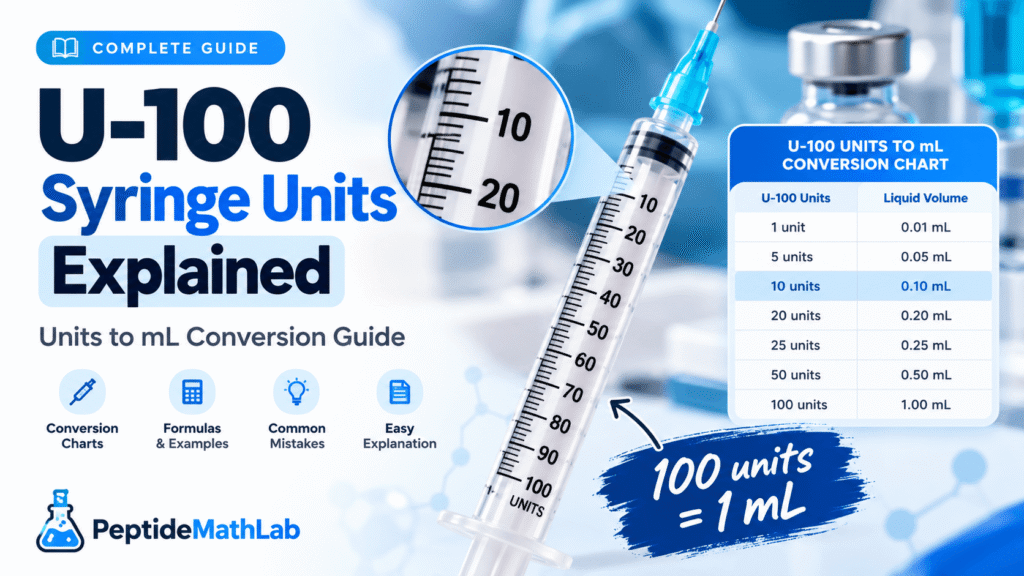
A U-100 syringe uses a scale in which 100 units correspond to 1 millilitre (mL). That means every single unit on the U-100 scale represents 0.01 mL of liquid.
This relationship is simple, but confusion often begins when syringe units are mixed with measurements such as mg, mcg and mL.
The key distinction is that the markings on a U-100 syringe tell you about the calibrated liquid volume represented by the scale. They do not automatically tell you how many milligrams or micrograms of a substance are present in that liquid.
According to MedlinePlus, standard U-100 insulin contains 100 units in 1 mL, and insulin syringes designed for U-100 are marked to correspond with that concentration. FDA syringe guidance likewise describes a standard 1 mL insulin syringe as 100 units and a 0.5 mL syringe as 50 units. MedlinePlus
This guide focuses on the mathematics of the U-100 scale, not dosing or administration instructions.
What Does U-100 Mean?
The simplest relationship to remember is:
100 U-100 units = 1 mL
From there:
1 unit = 0.01 mL
So if you know either the number of units or the liquid volume, you can convert directly between them.
For example:
10 units = 0.10 mL
25 units = 0.25 mL
50 units = 0.50 mL
100 units = 1.00 mL
The FDA also identifies U-100 insulin products as containing 100 units per mL, which is the basis of the U-100 scale. Purple Book Search
U-100 Units to mL Conversion Chart
| U-100 units | Liquid volume |
|---|---|
| 1 unit | 0.01 mL |
| 2 units | 0.02 mL |
| 5 units | 0.05 mL |
| 10 units | 0.10 mL |
| 15 units | 0.15 mL |
| 20 units | 0.20 mL |
| 25 units | 0.25 mL |
| 30 units | 0.30 mL |
| 40 units | 0.40 mL |
| 50 units | 0.50 mL |
| 60 units | 0.60 mL |
| 70 units | 0.70 mL |
| 75 units | 0.75 mL |
| 80 units | 0.80 mL |
| 90 units | 0.90 mL |
| 100 units | 1.00 mL |
For values that are not shown in the table, the relationship remains the same.
A user who wants an interactive result can use the Peptide Syringe Calculator to convert and visualize U-100 scale values.
How to Convert U-100 Units to mL
The mathematical relationship is:
mL = U-100 units ÷ 100
If the syringe scale shows 20 units:
20 ÷ 100 = 0.20 mL
If it shows 5 units:
5 ÷ 100 = 0.05 mL
If it shows 75 units:
75 ÷ 100 = 0.75 mL
This conversion does not require a substance concentration because both values represent the same underlying liquid volume.
Concentration becomes necessary only when you want to connect that volume to a mass measurement such as mcg or mg.
How to Convert mL to U-100 Units
To work in the opposite direction:
U-100 units = mL × 100
For example:
0.10 mL × 100 = 10 units
0.25 mL × 100 = 25 units
0.50 mL × 100 = 50 units
1.00 mL × 100 = 100 units
This is a direct volume-to-scale conversion.
How Many mL Is 10 Units?
On a U-100 scale:
10 units = 0.10 mL
This is one of the most common U-100 conversion questions.
Because:
1 unit = 0.01 mL
then:
10 × 0.01 mL = 0.10 mL
However, this tells you only the liquid volume.
It does not tell you how many mcg or mg are present in that 0.10 mL unless the concentration is also known.
How Many mL Is 20 Units?
On a U-100 scale:
20 units = 0.20 mL
The calculation is:
20 ÷ 100 = 0.20 mL
The same principle applies whether the U-100 syringe has a total capacity of 30, 50 or 100 units. Its maximum capacity may differ, but the U-100 scale still represents 100 units per millilitre.
How Many mL Is 50 Units?
50 U-100 units = 0.50 mL
This also means that a 0.5 mL U-100 syringe can hold 50 units on its printed scale.
FDA syringe guidance identifies standard insulin-syringe capacities including 1.0 mL/100 units and 0.5 mL/50 units. U.S. Food and Drug Administration
How Many Units Is 0.1 mL?
The conversion also works in reverse.
0.1 mL = 10 U-100 units
Similarly:
0.2 mL = 20 units
0.3 mL = 30 units
0.5 mL = 50 units
1 mL = 100 units
This is why it is important not to reverse the relationship between 0.1 and 0.2 mL.
U-100 Units Are Not the Same as mcg or mg
This is where many conversion mistakes happen.
mL describes liquid volume.
mcg and mg describe mass.
The U-100 scale gives you a calibrated relationship to liquid volume, but it does not by itself tell you how much mass is dissolved in that volume.
For example:
10 U-100 units = 0.10 mL
But asking:
“How many mcg are in 10 units?”
does not have one universal answer.
You must also know the concentration of the solution.
If you need to convert a user-entered microgram value into the corresponding volume and U-100 scale measurement, use the mcg to Units Calculator.
Why Concentration Changes the Result
Imagine two solutions.
Both may be measured using the same 0.10 mL liquid volume.
However, one solution might contain:
1,000 mcg/mL
while another contains:
2,500 mcg/mL
For the first concentration:
0.10 mL represents 100 mcg
For the second:
0.10 mL represents 250 mcg
The syringe volume did not change.
The U-100 mark did not change.
The amount represented by that liquid changed because the concentration changed.
This is why PeptideMathLab keeps concentration, mass and liquid-volume calculations separate instead of treating syringe units as a universal substance amount.
You can calculate a solution’s mass concentration with the Peptide Concentration Calculator.
How mcg, mg, mL and U-100 Units Fit Together
A useful way to think about these measurements is as separate stages.
First, mg or mcg tells you how much substance is being represented.
Next, mg/mL or mcg/mL tells you the concentration.
That concentration lets you determine the required mL volume.
Finally, the calculated mL value can be represented on a U-100 scale.
For a broader calculation that handles these relationships together, use the main Peptide Calculator.
Example: Converting 250 mcg Into U-100 Units
Suppose a mathematical example has a concentration of:
2,500 mcg/mL
and you want to find the volume corresponding to:
250 mcg
The liquid volume is:
250 ÷ 2,500 = 0.10 mL
On a U-100 scale:
0.10 mL × 100 = 10 units
Therefore:
250 mcg at 2,500 mcg/mL = 0.10 mL = 10 U-100 units
Now imagine the concentration were only 1,250 mcg/mL.
The same 250 mcg would mathematically correspond to:
0.20 mL = 20 U-100 units
This demonstrates why concentration must be included whenever mass and syringe-unit calculations are connected.
For calculations like this, the mcg to mL Calculator can calculate the liquid volume first and show the corresponding U-100 scale value.
30-Unit, 50-Unit and 100-Unit U-100 Syringes
U-100 syringes can have different total capacities.
A 30-unit syringe holds up to 0.30 mL.
A 50-unit syringe holds up to 0.50 mL.
A 100-unit syringe holds up to 1.00 mL.
The important point is that these capacities do not change the underlying U-100 relationship.
On each U-100 scale:
10 units still corresponds to 0.10 mL.
What can differ between products is the spacing and smallest printed graduation, so users should read the markings on the actual device rather than assuming every syringe has identical tick spacing.
U-100 Is Not the Same as Every Other Syringe Scale
The U-100 designation matters.
You should not assume that a syringe using another calibration system has the same units-to-mL relationship.
MedlinePlus specifically notes that the insulin type should match the syringe type, while FDA guidance describes U-100 syringes as being marked specifically for U-100 insulin. MedlinePlus
For PeptideMathLab calculations, any result labelled U-100 units refers specifically to the U-100 mathematical scale.
Common U-100 Conversion Errors
The most common errors are treating syringe units as if they directly represented mg or mcg, reversing units and mL, forgetting that concentration is required for mass-to-volume conversions, confusing 0.1 mL with 0.01 mL, or assuming every syringe scale is U-100.
A good check is to return to the basic relationship:
100 units = 1 mL
If your direct units-to-mL conversion contradicts that relationship, something has gone wrong.
For complex vial calculations, use the Peptide Reconstitution Calculator instead of trying to combine several conversion steps manually.
Frequently Asked Questions
What does U-100 mean on a syringe?
U-100 indicates a scale corresponding to 100 units per 1 mL. Therefore, each unit corresponds to 0.01 mL on that scale. MedlinePlus
How many mL is 1 U-100 unit?
1 unit = 0.01 mL.
How many mL is 5 units?
5 units = 0.05 mL on a U-100 scale.
How many mL is 10 units?
10 units = 0.10 mL.
How many mL is 20 units?
20 units = 0.20 mL.
How many mL is 25 units?
25 units = 0.25 mL.
How many mL is 50 units?
50 units = 0.50 mL.
How many units are in 1 mL?
On a U-100 scale, 1 mL corresponds to 100 units.
Is 10 units always 250 mcg?
No. Ten U-100 units corresponds to 0.10 mL, but the amount of substance contained within that volume depends on the concentration.
Can I convert mg directly into syringe units?
Not without additional information. You first need the concentration so the mg amount can be converted into mL. The mL can then be represented on the U-100 scale.
Does syringe size change how many mL 10 U-100 units represents?
No. On the U-100 scale, 10 units corresponds to 0.10 mL. A different barrel capacity changes how much the syringe can hold, not the basic U-100 volume relationship.
Use PeptideMathLab’s Calculation Tools
If you only need a direct volume visualization, use the Peptide Syringe Calculator.
For concentration-dependent conversions, use the mcg to Units Calculator or mcg to mL Calculator.
For a calculation involving vial amount, liquid volume, concentration and U-100 units together, use the Peptide Reconstitution Calculator.
Educational Calculation Notice
PeptideMathLab provides mathematical conversion tools and educational information only. This guide explains the numerical relationship represented by a U-100 scale. It does not recommend a dose, treatment, injection method or appropriate amount of any substance.
Always verify the labels, units and concentration associated with the values being entered.
References
MedlinePlus — Giving an insulin injection. MedlinePlus states that standard U-100 insulin contains 100 units in 1 mL and describes standard U-100 syringe markings. MedlinePlus
U.S. Food and Drug Administration — Guidance on piston syringes. FDA guidance describes standard insulin-syringe sizes including 1.0 mL/100 units and 0.5 mL/50 units and identifies U-100-specific markings. U.S. Food and Drug Administration.